Electric cars are great.
They’re extremely quiet, more refined than the vast majority of gas-powered cars, and they’re even easier to recharge, thanks to the countless DC fast chargers popping up everywhere. Gone are the days when a Nissan Leaf owner had to meticulously plan a 200-mile trip — usually with a third-party website — just to make sure he arrived at his destination with a little power left in the battery.
But if there’s one thing I’ve learned after doing this work for more than a decade, it’s that electric cars aren’t for everyone — at least not yet. That’s why hybrids are having such a moment in 2025, and why 2026 will be even bigger.

Photo by: Toyota
The near-term solution to the affordability problem
On the whole, an electric car that can do it all is still more expensive than a comparable combustion car. And charging is still not ideal for many people. Apartment dwellers have no choice but to use DC fast chargers, which are, by and large, more expensive than charging at home outside peak hours. Sometimes, it’s more expensive than filling up with gas.
This leaves one solid option for many car shoppers who are skeptical about electric cars or already have all the numbers and fail when considering switching to an electric car: hybrids or plug-in hybrids.
2026 Subaru Crosstrek Hybrid
Photography: Patrick George
It still burns gas and produces CO2 emissions, so it’s not as environmentally friendly or as smooth to drive as a full electric car. But they’re cleaner than traditional gas cars, can save owners money in the long run, and are the perfect gateway to electric vehicles. The main selling points are simple: improved fuel efficiency compared to non-hybrid cars and lower prices than similar electric cars.
Starting at under $30,000, the new Chevrolet Bolt and Nissan Leaf are decent cars, but it’s hard to recommend them to someone with a maximum budget of $25,000 for a new car that needs to be reliable and easy to use over time. But the Toyota Corolla Hybrid, which starts at $25,000, is hard to argue with.
Honda’s next generation of hybrid and electric cars
Photo by: Honda
Many Americans already know this fact, and automakers are banking on people’s reluctance to switch to all-electric garages. In the first quarter of this year, about 22% of light-duty vehicles sold in the U.S. were hybrids or plug-in hybrids, up from about 18% in the first quarter of 2024, according to the U.S. Energy Information Administration (EIA). People may not be flocking to electric cars, but they are choosing battery-powered options over all-gas-powered cars.
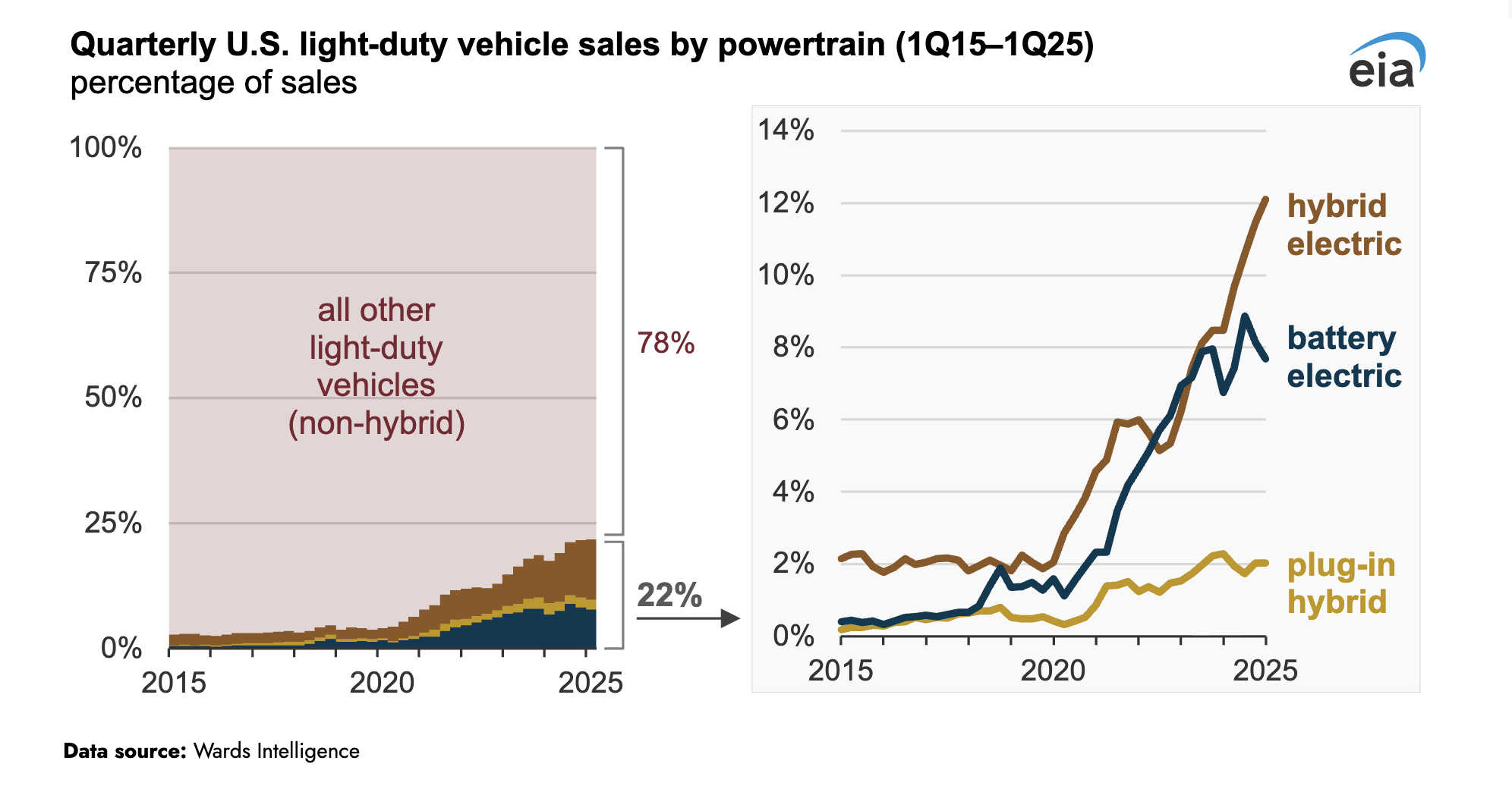
Hybrid vehicle sales: via EIA
Photo: US Energy Information Administration
Conventional hybrids are more common than plug-in hybrid electric vehicles (PHEV) in the United States, although they are not the same in other parts of the world. In the third quarter, sales of conventional hybrids — which have a gas engine, a small electric motor and a small, high-voltage battery — increased 20% in the United States compared with the same period last year, according to analytics firm PricewaterhouseCoopers.
Meanwhile, sales of plug-in hybrid electric vehicles (PHEV) — which have a larger battery and a more powerful electric motor — rose in the third quarter by just 3%. But that’s just the tip of the iceberg, as car companies rush to fill the potential gap left by electric vehicles.
Photo by: Volvo
The data was even more impressive in Europe. Hybrid cars are currently the most popular type of new car in this market, accounting for 35% of the market. Combined with plug-in hybrid electric vehicles (PHEV), they have outsold vehicles powered only by gas or diesel engines. And in China, despite its big lead in electric cars, hybrid car sales are on the rise as buyers outside cities face some of the same charging challenges as everyone else.
The great hybrid rush is coming soon
Some automakers have had ambitious goals to become all-electric brands by 2030, 2035 or later. Faced with the harsh reality of the market, many have pushed back by postponing or canceling new electric vehicles. They’re now looking at ways to entice buyers with more hybrid and plug-in hybrid options, many of which will be built locally in the US.
2026 Nissan Rogue Plug-in Hybrid
Photo by: Nissan
This is good news for now. Buying a hybrid can significantly lower a household’s gas bills compared to an older gas car, with most new hybrids paring their conventional counterparts after about three years, according to the EPA’s Nifty Hybrid Savings Calculator.
It’s not lost on me that hybrids are a bit more expensive than old gas stoves, and that plug-in hybrids can save owners some serious cash if they have a cheap, easy place to charge overnight and hate stopping to recharge on road trips. However, it has its place in the market now, as more auto and shipping industries begin to understand what consumers want and come up with ways to reduce costs further.
Photo: Mac Hogan/InsideEVs
Porsche, Kia, Hyundai, Volvo, Nissan, Honda and others have serious plans to invest a lot of money in new electric motors that are easier to push inside existing car platforms. Toyota has done this very well for more than a decade, and it’s not about to stop anytime soon, because it wants to sell as many hybrids, hybrids, and electric vehicles as possible. Meanwhile, Toyota had a banner year of sales in the United States on the strength of its hybrid lineup, and now several other automakers are trying to follow suit.
And that’s good, because these are all companies that need to make money to keep the lights on. If it also means car buyers can save some money on gasoline in the long run, then that’s absolutely ideal. I remember the first time I drove a Toyota Prius; It was a great experience driving on electricity at low city speeds, and I couldn’t help but try to keep fuel consumption as low as possible. This same experience may convince other gas fanatics to eventually ditch dinosaur fuel for something more silent.
Photo by: Mercedes-Benz
So, expect 2026 to be full of hybrid and plug-in news, and I’m all for it. But I want to be clear about one thing. These two types of engines are fine now, but they are a temporary solution until the world discovers that there are better ways to get from point A to point B. That solution could be an electric car, public transportation, an e-bike, or something else — but I’m getting ahead of myself here.
Technology is advancing so quickly, it won’t be long before $25,000 or even cheaper electric cars arrive to lure more people behind the wheel of a gas-free car. Solid-state batteries that will enable longer ranges are also expected to become widely available by the end of the decade, and some companies have had success creating more efficient combustion engines.
Until that happens, the solution for many is to hide in plain sight.
We want your opinion!
What would you like to see on Insideevs.com?
Take our 3-minute survey.
-InsideEVs Team