navigation
DisplayPort 1.4 and DisplayPort 1.2 are two of the most useful connectors for combining desktop computers and high-end monitors. DisplayPort is a digital video output interface found in laptops and desktop computers, and has evolved through several DisplayPort versions, including DP 1.2, 1.4, 2.0, and 2.1. DisplayPort is a digital display port interface primarily used to connect computers to monitors, supporting higher resolutions, refresh rates, and advanced features such as HDR and multi-monitor setups. They’re two generations of the same connector type, with DisplayPort 1.4 being the more capable and, in 2023, the most popular option. Although it has begun to be replaced by the newer DisplayPort 2.0/2.1 connector, DisplayPort 1.4 is still a very important connector and cable type in desktop computing – especially gaming.
Overview of DisplayPort and its evolution
But where does that leave DisplayPort 1.4 versus 1.2? Although the latest DisplayPort standards are not in use anymore, they are still perfectly usable for many mainstream resolutions and refresh rates and will remain so for years to come. Each version of Displayport offers new features and increased bandwidth, making it important to know which version your device supports. Especially if there’s an option for DisplayPort 1.2 via another type of connector, like USB-C.
DisplayPort vs. HDMI: Different use cases
While living room gaming consoles, Blu-ray players, and HTPCs often use the humble HDMI connection for their video and audio transmission needs, high-end desktop PCs use something different. DisplayPort is a much more capable cable type, and has been the connection of choice for high-end monitors and graphics cards for years, enabling high-resolution video output and advanced display features. It’s important to consider the differences between DP 1.2 and DP 1.4 in terms of bandwidth, features, and hardware compatibility, which affect display resolution and performance for gaming and professional use.
Key Features of DisplayPort 1.2
Even DisplayPort 1.2, originally released in 2010, offers more bandwidth than all but the latest HDMI standards. The data rates of DP 1.2 allow for features such as Multi-Stream Transport (MST) and multi-monitor support, while DisplayPort 1.4 increases data rates even further, enabling higher resolutions, refresh rates, HDR, and Display Stream Compression (DSC) for advanced video output. Active Displayport cables, which have built-in electronics to amplify and condition the signal, are recommended for longer cable runs or high-performance setups like 4K at 120Hz or 8K resolution.
This doesn’t mean DisplayPort 1.2 is bad. In fact, in the DisplayPort 1.4 vs. 1.2 battle, you might be surprised at how competitive it is. DP 1.2 builds on previous versions of DisplayPort, with each iteration providing improvements in bandwidth, resolution support, and overall performance. Dual mode allows DisplayPort outputs to be connected to HDMI or DVI displays using passive adapters, increasing compatibility with a wide range of displays.
Is DisplayPort 1.2 or 1.4 better?
When considering the question of whether DisplayPort 1.2 or 1.4 is better, it is essential to understand the key differences and advantages that each version offers. DisplayPort 1.4 is the latest and most advanced version, offering several important improvements over DisplayPort 1.4. One notable improvement is the increase in maximum bandwidth, which allows for higher resolutions and refresh rates. The maximum resolution supported by DisplayPort 1.4 is 8K at 60Hz, while DisplayPort 1.2 supports up to 4K at 60Hz. DisplayPort 1.4 supports resolutions up to 8K at 60Hz or 4K at 240Hz, while DisplayPort 1.2 supports resolutions up to 4K at 60Hz.
Advanced features of DisplayPort 1.4
Furthermore, DisplayPort 1.4 offers support for Display Streaming Compression (DSC), enabling higher resolutions without compromising on image quality. It also offers enhanced High Dynamic Range (HDR) support, ensuring more vivid and lifelike colors. However, it should be noted that although DisplayPort 1.4 offers these advanced features, not all devices and displays may support this version. Not all features are supported by every device, so it’s important to check which resolutions and refresh rates your device supports. Some devices may have limitations that differ from the standard technical specifications, especially regarding support for specific transmission modes and bandwidth. Therefore, before making a decision, it is necessary to check your hardware specifications and ensure compatibility with the required resolution and refresh rate requirements.
Bandwidth and backward compatibility
At the heart of every high-end cable standard are some numbers that define what it can do. DisplayPort cables have provided an impressively wide data transfer bandwidth since their first iteration, and this has only been improved in successive generations. When it comes to DisplayPort 1.4 versus 1.2, the newer standard is more capable, but DisplayPort 1.2 is still impressive. DisplayPort 1.4 is backward compatible, ensuring that devices using older standards are still able to connect and work properly. Always review the technical specifications of your cables and devices to ensure optimal performance.
DisplayPort 1.2 technical specifications
DisplayPort 1.2 delivers a maximum aggregate bandwidth of 21.6 Gbps across its four lanes and a maximum aggregate data rate of 17.28 Gbps.
It has access to the three basic DisplayPort transmission modes, including RBR, HBR, and HBR2, but is unable to take advantage of the more advanced transmission modes, such as HBR3, or any of the UHBR transmission modes.
However, even without that extra data rate, it still supports a wide range of resolutions and refresh rates, including 4K at 60Hz with 10-bit color, or 1080p at over 200Hz.
Features offered in DisplayPort 1
The dp port on DisplayPort 1.2 devices supports higher resolution and increased bandwidth, making it suitable for demanding display setups. DisplayPort 1.2 also introduced the ability to include multiple independent video streams, allowing compatible displays to be daisy-chained together. It was also the first DisplayPort standard to support stereoscopic 3D, added support for svRGB and Adobe RGB 1998 additional color spaces, and improved auxiliary channel bandwidth. It also brought with it a Mini DisplayPort connector, although that has been largely discontinued as of 2023.
DisplayPort 1.2 was further enhanced with the Mini 1.2a update to the DisplayPort standard, which introduced support for AMD’s FreeSync using a VESA Adaptive Sync dock.
DisplayPort 1.4 technical specifications
Despite this impressive feature set, the DisplayPort 1.4 vs. 1.2 head-to-head is still largely one-sided.
By comparison, DisplayPort 1.4 has the same four-lane architecture but expands the maximum total bandwidth to 32.40 Gbps, and the maximum total data rate to 25.92 Gbps. This was enabled by the use of the new HBR3 transport mode, which unlocked 4K at up to 120Hz, and lower resolutions over 400Hz with 8-bit colour. The increased bandwidth in DisplayPort 1.4 enables support for higher resolutions, higher refresh rates, and advanced features such as multiple high-resolution displays.
These numbers match those for DisplayPort 1.3 because DisplayPort 1.4 was more of a feature update than an actual cable or design change. However, it has incorporated Display Stream Compression (DSC) 1.2, a lossless compression format that opens up a wider range of resolutions and refresh rates than its bandwidth would otherwise allow.
It also added support for the important HDR10 standard for HDR metadata, heralding a new era of visuals on compatible displays. The maximum number of included audio channels has also been extended to 32.
Displayport 1.4 vs 1.2: Resolutions, refresh rates, and more
As impressive as the raw numbers look on the spec sheet, what they mean in the real world is access to higher refresh rates and resolutions. DisplayPort 1.4 versus 1.2 is a battle of features, yes, but it’s also a head-to-head competition over which video and gaming setups the cables can actually support.
When it was introduced in 2010, DisplayPort 1.2 ushered in a new era of cutting-edge data transfer, with support for features like adaptive sync and panel self-refresh. But it also improved the standard’s resolution and refresh rate support, opening up the option of 5K up to 30Hz, 4K up to 75Hz, and 1080p up to 240Hz – standards that were previously impossible to reach with a DisplayPort connection.
There have been important additions to Standard that have helped open up new, higher-resolution gameplay and refresh for PC players. This was especially important for higher refresh rate play in eSports and other competitive games, as the improved latency from the higher refresh rate has proven to make a noticeable difference in not only how smooth games are when playing, but how quickly more competitive players can react to games. This has created more competitive eSports, and more exciting games for viewers to watch. The video source, such as a computer or graphics card, must also support the required resolution and refresh rate to take full advantage of DisplayPort’s capabilities.
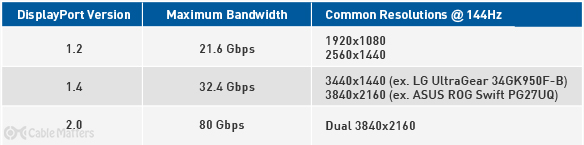
However, DisplayPort 1.4 takes things a step further. It supports 1440p resolution at up to 240Hz, and up to 4K at up to 120Hz. Like DisplayPort 1.3, it also supports 5K at up to 60Hz and up to 8K at 30Hz.
And that’s without taking into account DSC 1.2 support. DisplayPort 1.4 vs. 1.2 is a blast without even considering compression techniques, but with DisplayPort 1.4 supporting DSC 1.2, it’s much more capable. With DSC enabled, it can handle 4K at 60Hz with 30-bit/pixel color and HDR, and up to 8K at up to 60Hz. And you can go further if you’re willing to sacrifice some color accuracy with Chroma Subsampling.
DisplayPort 1.4 cables are fully backward compatible with older DisplayPort devices as well, whether you’re using a full-size Mini DisplayPort or Mini DisplayPort connection. While there are some benefits to purchasing a device that supports the DisplayPort 1.4 standard over DisplayPort 1.2, if you’re comparing DisplayPort 1.4 versus 1.2 cables, there’s little reason to consider the older alternative.
Which DisplayPort cables should you buy?
With all the improvements in DisplayPort 1.4, it wins easily. If you’re in the market for a DisplayPort cable, you should opt for a high-quality DisplayPort 1.4 cable from a company like Cable Matters. Even if your current devices only support DisplayPort 1.2, a high-quality DisplayPort 1.4 cable is still a great choice. It is compatible with your existing devices and may allow you to avoid replacing cables when you decide to upgrade your devices.
What’s new in 2026?
As we move into 2026, the DisplayPort landscape continues to evolve with the introduction of DisplayPort 2.1a, which is significantly superior to both DisplayPort 1.4 and 1.2. Delivering Ultra High Bit Rate (UHBR) of up to 80 Gbps over a four-lane configuration, DisplayPort 2.1a supports demanding resolutions and refresh rates, including 8K at 120 Hz with full color depth and no compression.
For users considering upgrading, it’s important to note that DisplayPort 2.1a takes full advantage of the latest Display Stream Compression (DSC) 1.3 standard for virtually lossless compression, enabling future support for resolutions up to 16K. Plus, improved Adaptive Sync technology reduces screen tearing and stutter, making it ideal for high-resolution gaming and professional video editing.
Backward compatibility remains a key feature, ensuring that devices with DisplayPort 2.1a can seamlessly connect to older DisplayPort versions with improved performance based on hardware capabilities.
When choosing cables and devices in 2026, prioritize those that support DisplayPort 2.1a and DP Alt Mode over USB-C for the best combination of bandwidth, compatibility, and advanced features. While DisplayPort 1.4 and 1.2 remain viable for many applications, investing in the latest standards will better prepare you for the high-resolution, high-refresh-rate demands of the future.